
A relief pipe disappears into a tank of water. Someone looks at the drawing and ticks “ammonia dealt with”.
That’s the bit that bothers me.
An absorption tank, often called a diffusion tank, can be the right answer for an ammonia refrigeration plant. I want to see what it’s been designed to do, what could stop it doing that job, and how the people looking after the plant know it’s ready.
Start with the relief calculation
Start with how much refrigerant the equipment needs to relieve under the governing overpressure scenario. Then verify that the selected relief devices can deliver that capacity through the installed discharge path. Where devices share a header, check which ones could discharge together.
Check what the tank adds to that discharge path. The relief pipework and the depth of the outlet below the water surface contribute to backpressure. The valve has to pass the required flow, and the tank has to handle what arrives over the design discharge period.
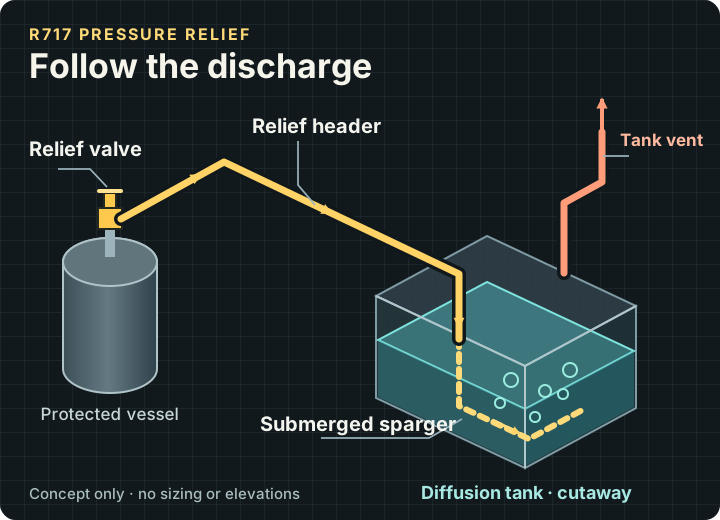
What happens when a relief valve opens?
The tank uses water to absorb ammonia vapour from the relief discharge. Absorption gives off heat. Figure 12 in Engineering New Zealand’s design guide shows 20°C inlet water and a mixed stream at about 62°C, using around 8.3 litres of water per kilogram of ammonia. The guide gives 40°C as an example limit for a polyethylene tank. Check the manufacturer’s rating for your tank, lining and wetted fittings at the expected ammonia concentration.
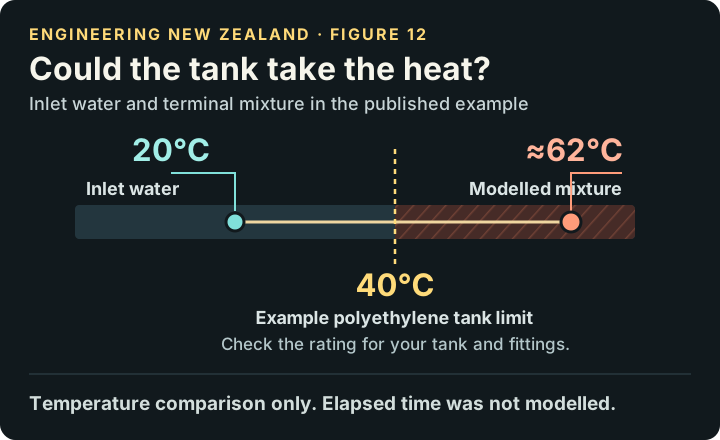
How quickly could your tank cross its temperature rating? The published model gives the mixed-stream temperature. To estimate the time to reach a given temperature during a discharge, you need the starting water volume and temperature, the relief flow over time, and the heat gained and lost by the tank.
When hot water lets vapour through
As the liquid heats up and takes on more ammonia, the equilibrium ammonia vapour pressure above it rises. That reduces the driving force for more ammonia to dissolve. As the tank approaches its effective absorption capacity, more of the incoming gas can bubble straight through and reach the vent. That’s vapour breakthrough. Hot, ammonia-rich liquid can also give off ammonia, and breakthrough can occur while the bulk liquid is still below its boiling point.
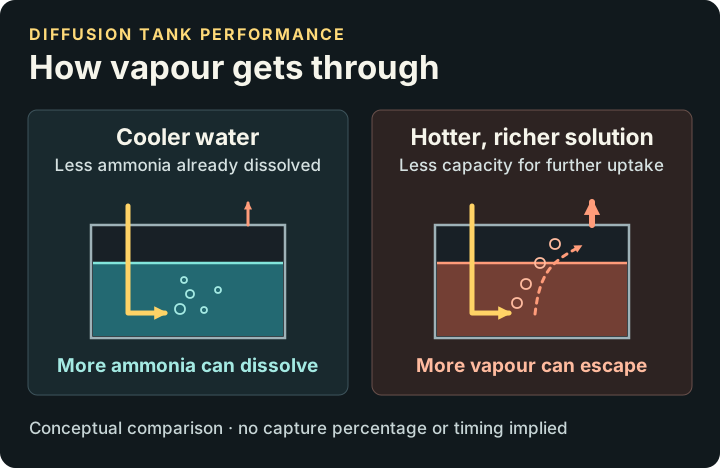
At around atmospheric pressure, a 10% ammonia solution by mass starts boiling at roughly 70°C. A 25% solution starts at around 38–40°C. The boiling point depends on concentration and pressure. For the relief design, I want to know how much ammonia the tank can still capture as it heats up and loads with ammonia, and how much could reach the vent.
Where does the ammonia go if the tank vents or fails?
Engineering New Zealand’s relief-valve design guide reports a modelled vent discharge that could approach 750,000 ppm ammonia, or 75% by volume. That’s the concentration in the gas leaving the vent. What reaches a person depends on where the vent terminates, how the gas disperses and who’s nearby. A low vent outlet can put the discharge close to walkways, doors or fresh-air intakes.
If a lid comes off, a fitting gives way or the tank cracks, ammonia can escape closer to people and equipment. A restricted vent can also allow pressure to build and force vapour out through an unintended opening. A failed fitting or crack below the waterline can spill hot ammonia solution, which can keep giving off vapour. If the water level drops below the submerged discharge outlet, incoming ammonia may also bypass the water. Work through both the vapour path and the spill path.
It can stink. Use detection and the site emergency plan to guide decisions. People can become less sensitive to the smell during exposure.
Ammonia can also burn
NIOSH gives an approximate flammable range of 15% to 28% ammonia by volume in air. An ammonia-rich discharge can pass through that range as it mixes with air. That’s a reason to assess ignition sources where vapour could mix or accumulate, including the tank headspace and the area around the vent.
Have a competent person assess the installation against the applicable hazardous-area classification standard, such as AS/NZS IEC 60079.10.1. The headspace could be Zone 0 if an explosive gas atmosphere is present continuously, frequently or for long periods. An area near the vent or another release point could be Zone 1 if an explosive atmosphere is likely to occur occasionally in normal operation. The assessment sets the classification and its extent based on how often a flammable mixture can form, how long it can persist and the ventilation available. Assess major failures such as tank rupture separately in the loss-of-containment and emergency planning work.
What I want to see at the tank
Water level indication. Can someone verify the water is within the specified operating range? If there’s an external sight tube or gauge, check that its seals and fittings suit the expected ammonia concentration and temperature, and that it’s protected from impact. If the design relies on a low-level alarm, I’d want to see when it was last tested.
Secondary containment. If the tank leaks or overflows, where does the ammonia solution go? Check whether the bund or catchment can hold the credible liquid release. Follow the drainage as installed, including any path to stormwater or an occupied area.
Water chemistry and pH. If pH monitoring is part of the design, establish the normal range, when it’s checked and what happens when it moves outside that range. A pH reading on its own can’t establish how much ammonia is dissolved or how much more the tank can absorb. If the design relies on a limit for dissolved ammonia, use a measurement method suited to the expected concentration and solution conditions.
Tank construction. Check the lid, fittings, corrosion protection and supports, including the full operating weight. Check that the vent is clear and suitably located, that the design accounts for credible pressure and vacuum loads, and that it prevents water being drawn back into the relief line. Check freeze protection where it matters.
Show me the design and the last inspection
Find the design basis. Which relief valves discharge to the tank? What flow rate and duration was it designed for? Ask for the relief sizing and backpressure calculations alongside the assumptions used to size the tank.
Find the last inspection record. What did someone actually verify? I’d want to see the water level against the specified range, the results of the checks specified for the tank, and how faults were followed up. I’d also want to know who deals with the ammonia solution after a discharge and how the system is returned to service.
When does a tank make sense?
Where the site assessment and applicable requirements support it, I prefer a properly engineered vertical discharge to atmosphere. That still takes work. Rooflines, wind, fresh-air intakes, neighbours and places where people gather all matter. A discharge that looks fine in elevation can put ammonia where you least want it. At some sites, those consequences may make a well-designed absorption tank the better choice.
The question I’d put to the site